Is account-based marketing right for your organisation? 7 questions to assess your ABM readiness


Account-based marketing (ABM) can help B2B organisations focus sales and marketing efforts on the accounts that matter most. But ABM is not automatically the right approach for every organisation, market or growth challenge.
Before investing in campaigns, technology or personalised content, it is worth assessing whether the foundations are in place. Do you know which accounts deserve extra attention? Are sales and marketing prepared to work together? Do you understand the people involved in the buying decision? And can you commit enough time and resources to make the approach worthwhile?
In short, account-based marketing is most suitable when you have a defined group of high-value accounts, complex B2B buying processes and enough commitment from sales and marketing to focus on those accounts over time.
Use the seven questions below as a practical ABM readiness assessment. They will help you determine whether you are ready to start, or which foundations you should strengthen first.
What does ABM readiness mean?
Being ready for account-based marketing does not mean that everything has to be perfect before you start.
You do not necessarily need a large marketing team, an expensive ABM platform or years of experience. You do, however, need enough focus and commitment to work differently from traditional broad-based marketing.
ABM asks you to make choices. Which accounts matter most? Which people within those accounts do you need to reach? What do they care about? And what can sales and marketing do together to move the relationship forward?
Your level of readiness will also influence the type of ABM approach that makes sense. A highly personalised 1:1 programme requires more insight, resources and sales involvement than a scalable programme aimed at a larger group of accounts.
So the question is not simply, ‘Are we ready for ABM?’ It is also, ‘What level of ABM are we ready for?’
7 questions to assess your ABM readiness
1. Are your target accounts valuable enough to justify ABM?
Account-based marketing requires more focus per account than most broad demand generation programs. That means the potential value of an account needs to justify the additional investment.
This does not only mean looking at the size of an initial deal. Consider the wider commercial potential. Could the relationship grow over time? Are there opportunities for cross-sell or upsell? Is the account strategically important because of its market position, geography or long-term potential? A €10,000 opportunity and a €1 million strategic account are unlikely to warrant the same marketing and sales effort.
What matters is that you can explain why some accounts deserve more attention than others. If every potential customer has roughly the same value and your sales process is highly transactional, ABM may not be the most efficient model. In that case, broader demand generation could deliver a better return.
2. Can you clearly identify and prioritise the accounts you want to win or grow?
ABM starts with account selection, not personalization. A common mistake is to begin with campaign ideas before deciding which accounts are genuinely worth pursuing. A strong ABM program starts with a clear ideal customer profile and a defined target account list.
That selection can be based on factors such as commercial potential, strategic fit, existing relationships, market position, growth potential or buying signals. For existing customers, it may also include expansion potential, product penetration and the strength of the current relationship.
The important point is that the choice is deliberate. Ideally, sales and marketing should agree on which accounts receive priority and why. Those accounts can then be grouped or tiered based on their potential and the level of attention they require.
If you cannot yet explain what makes one account more valuable or relevant than another, account selection is the place to start.
3. Does your sales process involve a complex buying group?
ABM is particularly valuable in complex B2B buying situations. Most major B2B decisions are not made by one person. A buying group may include business leaders, technical experts, procurement, finance, end users and other stakeholders, all with different priorities and levels of influence.
That creates a challenge for traditional lead-based marketing. Generating engagement from one individual does not necessarily mean the account itself is moving closer to a decision.
Account-based marketing allows you to look at the buying process at account level. Who is already engaged? Which stakeholders are missing? Who could become a champion? Who might block the decision? And what information does each person need?
The more complex the decision and buying group, the more valuable a coordinated account-based approach can become. However, complexity alone is not enough. The commercial value of the accounts still needs to justify the additional effort.
4. Are sales and marketing prepared to jointly own the approach?
You cannot run effective account-based marketing as a marketing campaign with sales added at the end. Sales and marketing need to agree on the target accounts, objectives, stakeholder priorities, messaging and next actions. They also need a regular way to share what they are learning.
Sales may know that a particular stakeholder has recently joined the business. Marketing may see that several people from the account are engaging with a certain topic. Neither insight is particularly valuable if it stays within one team.
In successful ABM programs, information flows both ways. This does not mean sales and marketing need to agree on every detail, but they should share responsibility for moving priority accounts forward.
If sales sees ABM as ‘something marketing is doing’, or marketing does not involve sales until an account shows engagement, it is worth solving that issue before trying to scale the programme.
A small pilot with one account team can often be a better starting point than launching a large program across the organisation.
5. Do you have enough account and buyer insight to be relevant?
Personalization is only useful when it is based on something meaningful. Changing a company name in an advert or email is not account-based marketing. Relevance comes from understanding what is happening inside an account and why it matters to the people you want to reach.
That could include business priorities, strategic initiatives, market pressures, technology changes, organisational developments, stakeholder needs and existing relationships.
Internal knowledge is often a good starting point. Sales conversations, CRM data, customer research and previous opportunities may already contain valuable information. External research can then help fill the gaps.
AI can accelerate this process significantly. It can help analyse annual reports, news, company websites and large amounts of internal information, or identify possible patterns and hypotheses. But AI does not remove the need for human judgement.
Account research should give you better questions to ask and stronger hypotheses to validate. It should not create false certainty based on information that has never been checked with the customer.
If your current knowledge of an account is limited to industry, company size and job titles, strengthening your account and buyer insight should be an early priority.
6. Can you commit the time, people and resources ABM requires?
You do not need a huge budget to start with ABM, but you do need enough capacity to follow through. Research takes time. Sales and marketing need to meet. Content may need adapting. Stakeholders need to be mapped. Campaigns have to be monitored. And when an account starts to engage, someone needs to know what should happen next.
A common problem is not that organisations start too small. It is that they start under-resourced.
The type of ABM you choose should therefore match the resources available:
- A 1:1 program focused on a handful of strategic accounts allows for deep research and highly tailored activity.
- A 1:few approach groups accounts around similar challenges or opportunities, making it possible to reuse more of the insight and content.
- A 1:many approach can reach a larger defined account universe, using data, advertising and technology to create relevance at scale.
None of these models is automatically better than another. The right approach depends on the value of the accounts, the complexity of the opportunity and what your organisation can realistically support.
7. Can you measure progress and commercial impact at account level?
ABM measurement needs to go beyond leads. A single form fill does not tell you whether an account is moving closer to a buying decision. Equally, a target account may be progressing commercially even if nobody has downloaded an e-book.
Before starting, define what meaningful progress looks like. That could include improved stakeholder coverage, engagement from new members of the buying group, more senior conversations, meetings, opportunity creation, progression through the sales process, pipeline contribution or revenue.
The right indicators depend on your sales cycle and objective. For some strategic accounts, the first sign of success may simply be gaining access to an important stakeholder who had previously been unreachable. For others, commercial impact can be measured much more directly.
The key is to agree on these signals before launching the program. Otherwise, marketing and sales may both be looking at different definitions of success.
How ready are you for ABM?
You can use the 7 questions above as a simple diagnostic. Give yourself two points when the answer is clearly yes, one point when you are partly there, and zero points when the capability is largely missing.
- A score of 11 to 14 suggests that you have strong foundations for account-based marketing. Your next challenge is likely to be designing the right approach, choosing accounts and executing consistently.
- A score of 7 to 10 suggests that ABM could be a good fit, but there are some foundations to strengthen. Rather than waiting until everything is perfect, consider addressing the biggest gaps and testing the approach with a focused pilot.
- A score of 0 to 6 suggests that other priorities may need attention first. Improving your ideal customer profile, target account selection, buyer insight or sales and marketing alignment could create a much stronger basis for ABM later.
Treat the score as a diagnostic rather than a mathematical rule. One fundamental gap can outweigh a high overall score. If sales has no interest in the target accounts, for example, strong technology and data will not solve the problem.
When is account-based marketing probably not the right approach?
ABM is powerful, but it is not the answer to every marketing challenge. It may not be the right priority if:
- your average contract value is too low to justify additional account-level effort;
- your sales process is short and highly transactional;
- you cannot identify which companies are more valuable than others;
- sales does not work with named accounts or is unwilling to commit to the programme;
- your organisation does not have enough capacity to follow up on priority accounts;
- your main challenge is generating broad awareness or large volumes of demand;
- your ideal customer profile and core proposition are still unclear.
That does not mean you can never use ABM. It may simply mean another marketing or sales priority should come first. In fact, deciding not to start ABM yet can be just as valuable as launching a program too early.
Which type of ABM fits your organisation?
Readiness is not only about whether you should use ABM. It also helps determine the right level of account focus.
- 1:1 ABM is most suitable for a small number of strategically important accounts where the potential value justifies deep research, close sales involvement and highly tailored activity.
- 1:few ABM works well when groups of accounts share similar business challenges, characteristics or buying situations. You can create relevance without developing everything from scratch for every individual account.
- 1:many ABM allows you to focus on a larger defined account universe. Data, advertising technology and scalable content play a bigger role, while account selection and relevance remain central.
The more individual attention an approach requires, the stronger your readiness needs to be in areas such as account insight, resources and collaboration with sales.
What role do data, technology and AI play in ABM readiness?
Technology can make a strong ABM program more scalable, but it should not be the starting point. Reliable data matters because you need to know which accounts and stakeholders you are engaging with. Your CRM, marketing automation platform and advertising tools may already provide enough infrastructure to start.
Dedicated ABM technology can add value when you need to manage larger account lists, identify intent signals, orchestrate channels or measure account engagement across different systems.
AI is increasingly useful too. It can help teams research accounts faster, analyse buyer and company information, identify potential signals, adapt content and prepare more relevant sales outreach. But the same principle applies to both AI and ABM technology.
Technology can make a strong ABM approach more scalable. It cannot compensate for weak account selection, limited buyer insight or a lack of sales commitment.
Before buying new tools, make sure you know what problem you expect the technology to solve.
How to improve your ABM readiness
If the assessment has highlighted some gaps, you do not need to fix everything at once. Start with a small group of accounts where there is clear commercial potential and genuine sales interest. Build the approach together with the people responsible for those accounts and agree on what you are trying to achieve.
Then strengthen the account and buyer insight you need to become relevant. Combine what your organisation already knows with external research, AI-supported analysis and direct human validation.
Finally, decide how you will recognise progress before activity begins. That creates a shared view of success and makes it easier to learn from the pilot.
ABM maturity is usually built through doing, learning and refining, not through trying to design the perfect programme on paper.
Frequently asked questions about ABM readiness
– What makes a company ready for account-based marketing?
A company is usually ready for account-based marketing when it can identify a group of strategically valuable accounts, has enough insight to understand those accounts and has commitment from both sales and marketing to work on them together.
Other important factors include sufficient resources, a complex enough buying process to benefit from account-level coordination and the ability to measure progress beyond individual leads.
You do not need every capability to be fully mature before starting, but the core foundations should be strong enough to support a focused pilot.
– Do you need an ABM platform before starting ABM?
No. An ABM platform can help with account selection, intent data, advertising, orchestration and measurement, particularly when you are working with larger numbers of accounts.
But technology is not a prerequisite for starting account-based marketing. Many organisations can run an initial programme using their existing CRM, marketing automation, advertising platforms and sales tools.
It usually makes more sense to establish the approach first and then identify where technology could help you scale or improve it.
– Can a small marketing team use account-based marketing?
Yes, as long as the scope matches the resources available. A small team should not try to copy an enterprise ABM programme aimed at hundreds of accounts. Instead, focus on a small group of strategically important accounts or use a 1 approach where insight and content can be shared across similar organisations.
The principle is simple: focus resources where they have the greatest potential impact.
– How many accounts do you need for ABM?
There is no fixed number. A 1:1 program might focus on only a handful of strategic accounts, while a 1:many program could target hundreds.
The right number depends on the potential value of the accounts, the complexity of the buying process, your available resources and the level of personalisation you want to provide.
The important question is not ‘How many accounts should an ABM programme have?’ but ‘How many accounts can we support properly with the approach we have chosen?’
– Can you use ABM for existing customers?
Absolutely. Account-based marketing is not limited to winning new logos. It can also be highly effective for strategic customers where there is potential for expansion, cross-sell, upsell, retention or stronger engagement with different business units and stakeholders.
In many organisations, existing customers are some of the most attractive accounts for an ABM programme because there is already knowledge, access and commercial history to build on.
– How long does it take to see results from ABM?
There is no universal timeline because ABM usually follows the length of your existing B2B sales cycle. Early signs of progress, such as improved stakeholder engagement, new conversations or access to previously unreachable decision makers, may appear relatively quickly.
Pipeline and revenue impact often take longer, particularly for strategic accounts with lengthy or complex buying processes.
For that reason, successful ABM programs measure both leading indicators and commercial outcomes rather than waiting for closed revenue to determine whether the approach is working.
Ready to take the next step?
Still unsure whether account-based marketing is the right next step for your organisation?
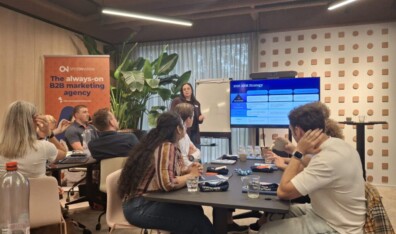
In our ABM getting started session, we look at your commercial goals, target market, current sales and marketing approach and potential target accounts. Together, we assess whether ABM makes sense for your organisation and what a realistic first step could look like.
Explore our ABM getting started session
Ready to scale your Account-based Marketing?
Share this article
Related insights


Grow your B2B Marketing knowledge
Subscribe to keep up with our latest B2B Marketing updates and exclusive events. Straight to your inbox, once a month.