The new rules of B2B growth: five predictions for 2027
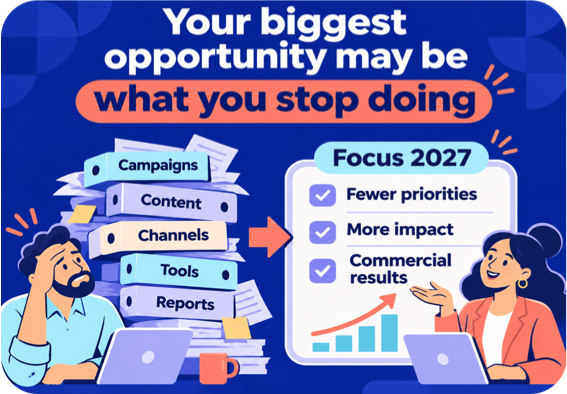

The execution challenge
More AI. More data. More pipeline. But does it lead to more B2B growth?
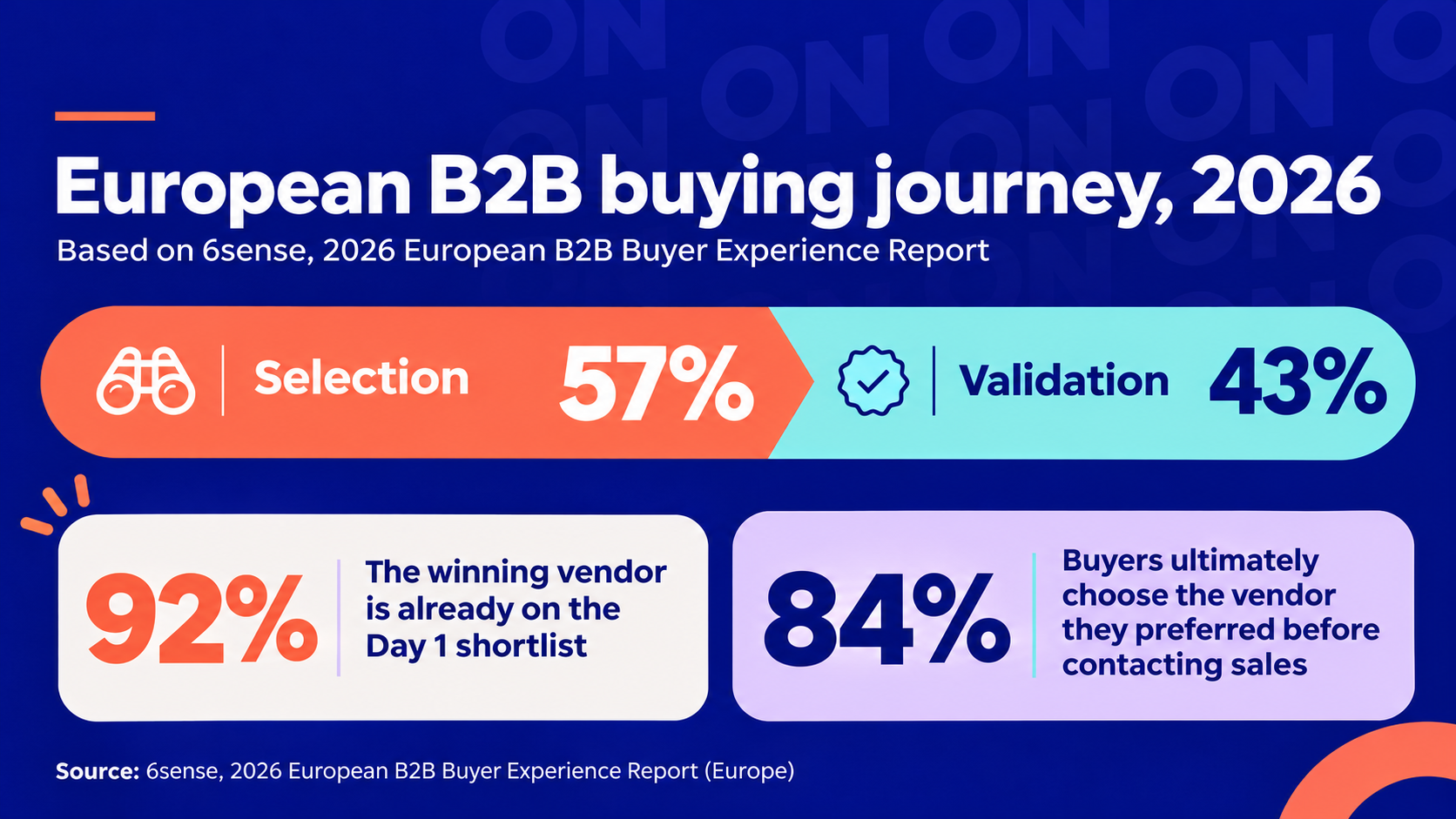
Not necessarily. In RAIN Group’s 2026 research, 47.2% of respondents reported an increase in qualified pipeline, while only 37.1% reported better quota attainment. Buyers, meanwhile, are doing more research independently and often form a preference before speaking to sales.
So what’s changing in 2027? Drawing on recent research and our experience at SPOTONVISION, I see five shifts that could help marketing and sales turn buyer intelligence into better decisions, stronger relationships and commercial growth.
The five 2027 B2B Marketing and Sales Predictions:
But first, let’s look back at our predictions of 2026.
Looking back at 2026: from insight to execution
Last year our 2026 predictions focused on combining machine precision with human understanding. That remains essential, especially as buyers form preferences long before speaking to sales. According to 6sense’s 2026 European Buyer Experience Report, the eventual winner was already on the Day 1 shortlist in 92% of cases. This reinforces our shift-left, shift-right view of the B2B buyer journey: build preference early and strengthen relationships after the sale. In 2027, the challenge is turning that understanding into commercial action.
Prediction 1: Nobody owns growth alone
The shift: from separate departmental targets to shared commercial ownership.
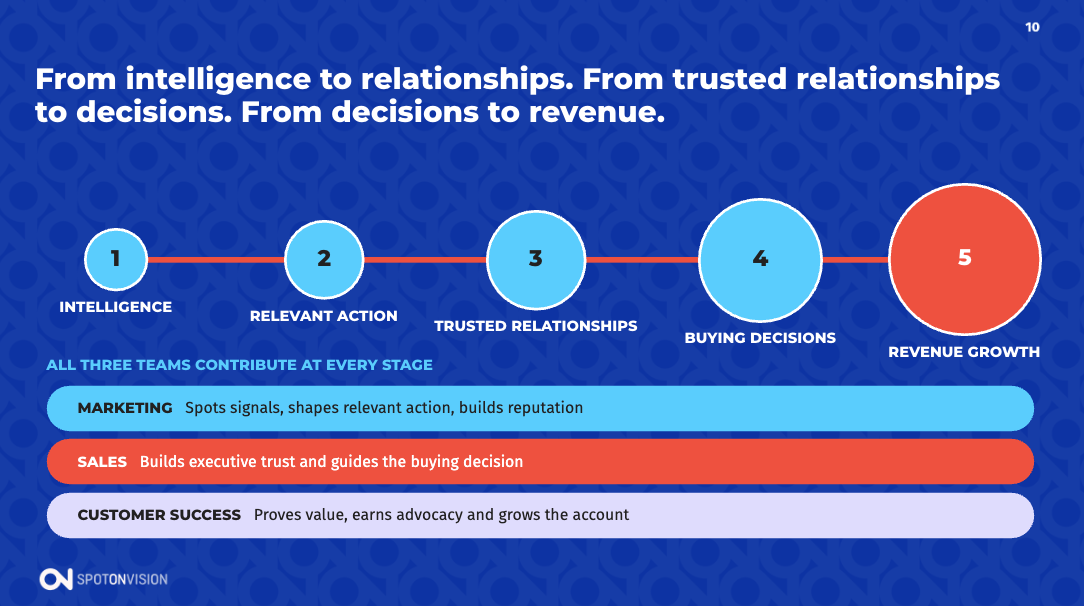
Sales and marketing alignment has been discussed for years. Yet joint meetings, lead handovers and dashboards do not necessarily produce shared priorities. We expect stronger B2B teams to organise around the accounts they want to win, retain and grow. Individual responsibilities will remain clear, but decisions and follow-through will serve the same commercial goals.
The 2026 Inflexion Group ABM Benchmarking Study found that 91% of programmes prioritised growth in existing accounts. Another 76% supported specific commercial opportunities. These were programme objectives, not achieved results. McKinsey’s 2026 Global B2B Pulse adds the buyer perspective: inconsistent information across teams was the leading reported reason for switching suppliers. Buyers notice the gaps that internal teams overlook.
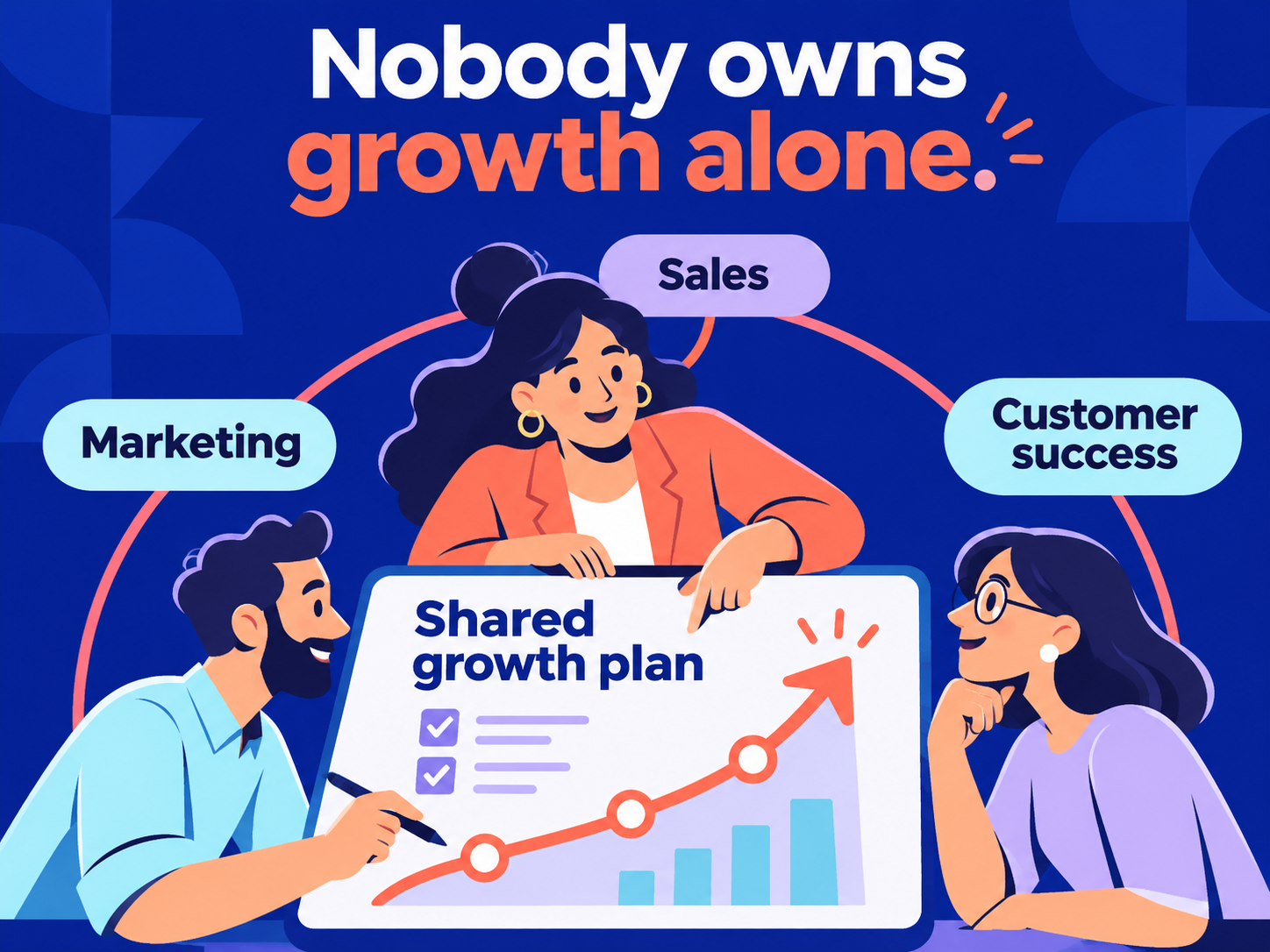
Shared ownership is not the same as vague collective responsibility. A practical growth plan shows which accounts matter, what the opportunity is, who makes the next move and how progress will be assessed. Marketing, sales and customer success still have different jobs. The difference is that they can explain how those jobs contribute to one commercial outcome.
Marketing: Plan around shared growth priorities
For marketing, this broadens the planning horizon beyond campaigns and lead volume. Brand and demand creation remain essential, alongside account development, deal support and customer expansion. The question becomes how these activities work together in priority accounts.
Sales: Bring customer intelligence into the plan
For sales, joint planning only becomes useful when customer knowledge is shared. Insight into relationships, objections, stalled decisions and expansion potential often sits with the account team. Bringing it into the discussion gives marketing a stronger basis for meaningful support.
A practical starting point is a joint review of a small number of strategic accounts, centred on progress, obstacles and ownership rather than separate activity reports. The next prediction shifts focus from machines to people, understanding what truly drives B2B buyers.
Prediction 2: Marketing needs to get closer to the deal
The shift: from campaigns and leads to helping buying groups decide.
Marketing helps create awareness and preference well before buyers are ready to purchase. The 6sense findings underline the importance of that early work. But once a strategic deal is active, another broad campaign may not address the real obstacle. The buying group may lack a shared business case, a critical stakeholder may be missing, or concerns may remain unresolved.
RAIN Group found that 82.4% of respondents considered losses to no-decision or the status quo challenging. Another 79.5% said larger buying groups were challenging. Gartner’s 2025 survey of 632 B2B buyers found that 74% of buying teams experienced unhealthy conflict. Teams reaching consensus were 2.5 times more likely to report a high-quality deal. This does not prove that deal-based marketing works. It does show why helping buyers reach agreement matters.
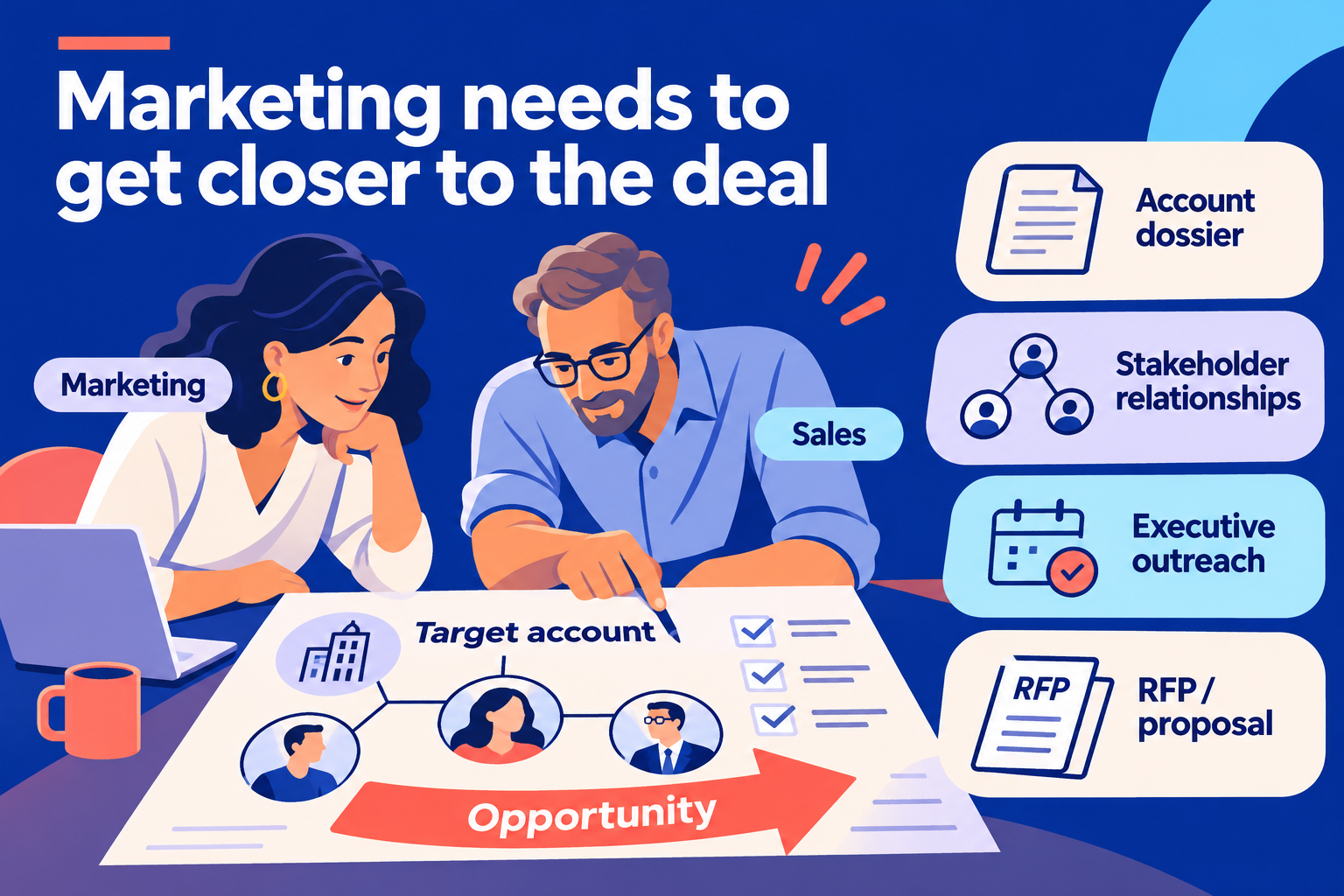
This creates an opening for deal-based marketing, also called pursuit marketing. Marketing and sales bring different expertise to a handful of high-value opportunities: account research, stakeholder understanding, executive engagement, tailored messages and materials that internal champions can share. Rather than simply improving the proposal, the joint effort helps a buying group reach a confident decision.
This level of support is not necessary for every deal. Its value is most likely to be found where complexity, strategic importance and potential return justify the investment. Broad demand creation and early preference-building remain important alongside it.
Marketing: Help buying groups make decisions
For marketing, this means contributing expertise at decisive points in the opportunity, not becoming a last-minute proposal desk. Repeatable approaches to stakeholder mapping, executive engagement and buyer enablement could make that support more consistent.
Sales: Involve marketing earlier in strategic deals
For sales, the implication is earlier collaboration. Sharing decision criteria, stakeholder concerns and competitive context gives marketing a chance to contribute before the RFP arrives. Sales retains responsibility for the opportunity, while both teams help the buyer move forward.
An early test could focus on two strategic opportunities and examine whether joint buying-group support improves access, understanding and deal progression.
Prediction 3: More AI won’t fix your go-to-market problem
The shift: from AI productivity to commercial impact.
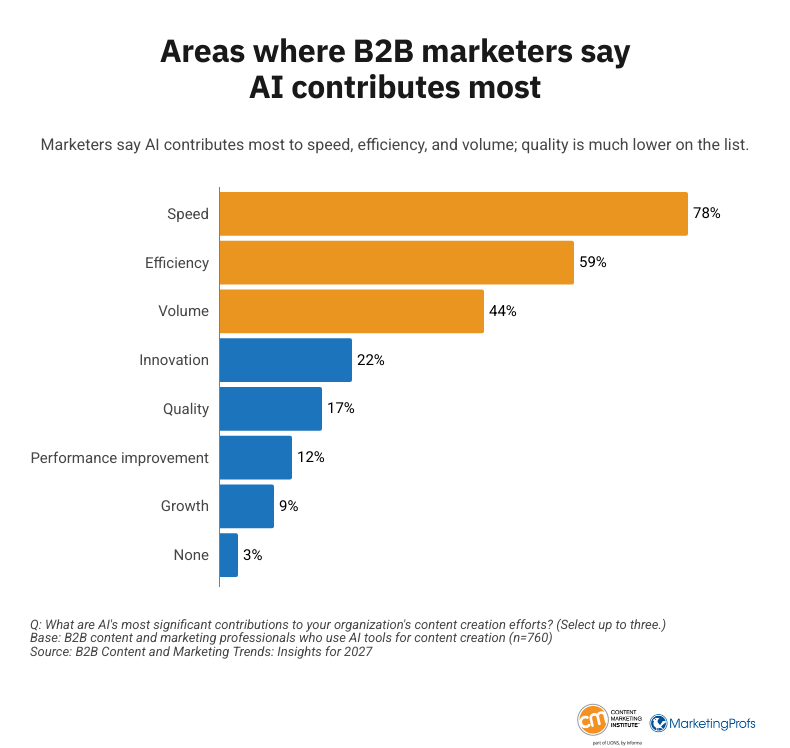
AI helps us create content, research accounts and handle administration faster. But does it help us make better decisions? In the Content Marketing Institute and MarketingProfs research for 2027, 78% of surveyed B2B marketers cited speed as a benefit of AI in content creation. Only 17% cited quality and 9% growth. These are perceptions about content creation, not all AI use.
Sales faces a similar gap. RAIN Group found that 70.1% reported limited AI use in sales and only 15.4% extensive use. For 39.5%, integrating AI into workflows was a barrier. McKinsey found generative AI adoption among 44% of market growth leaders, compared with 22% of laggards. That is an association. It does not prove that AI caused the growth.
The opportunity may lie less in producing more outputs and more in connecting intelligence to action. A signal becomes useful when it is checked against account context, existing relationships and a plausible business need. For example, an increase in AI-related hiring may suggest a relevant conversation, but it is not proof of purchase intent. AI can support research and interpretation; people still need to validate the evidence and decide what to do.
Marketing: Turn AI insights into commercial action
For marketing, the next stage of AI maturity is likely to involve fewer isolated experiments and more repeatable workflows. Account prioritisation and sales preparation are promising examples, provided the information is checked and someone is responsible for acting on it.
Sales: Use AI to create more relevant conversations
For sales, better AI support should be visible in the relevance of conversations. A useful briefing explains why an account matters, why the timing may be right and what the buyer could find valuable. Feedback from real conversations is essential to improve that intelligence.
One useful experiment for 2027 is to trace a buying signal through to a sales conversation and assess its relevance and commercial effect, not just the time saved.
Prediction 4: From counting metrics to understanding buying behaviour
The shift: from engagement scores to a fuller understanding of the buying group.
Marketing can count clicks, visits, intent scores, leads and engaged accounts. These measures have value, but they do not tell the full story of a buying decision. At the Global ABM Conference in London, Nick Mason of Turtl questioned whether replacing marketing qualified leads with marketing qualified accounts truly advances our understanding of customers.
The missing context is often found in the buying group itself. Who is driving change? Where are the doubts? Which interests conflict? RAIN Group’s sales performance profiles show why diagnosis matters: similar pipeline trends can conceal very different conversion and quota outcomes. The numbers are a starting point, not the explanation.
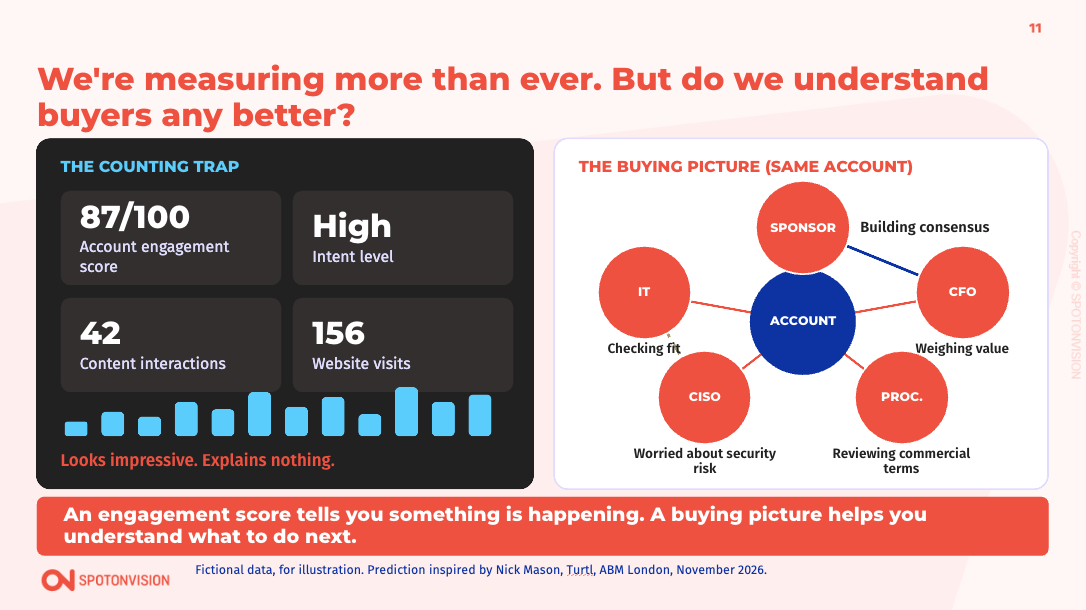
Consider an account with a high engagement score. The score tells us there is activity. It cannot tell us whether the CFO supports the business case, IT sees a fit or the sponsor can secure internal agreement. Those details determine what happens next. In 2027, the ability to explain this context could become more valuable than reporting another increase in engagement.
This does not make metrics redundant. Buying-group coverage, stakeholder access, meaningful meetings and opportunity progression provide evidence that can support or challenge the account story. Used together, quantitative and qualitative insight give teams a more reliable basis for decisions.
Marketing: Explain what’s happening inside the account
For marketing, a useful account update goes beyond a score. It explains who is involved, what has changed, what may be blocking progress and where there is an opportunity to help.
Sales: Add the human context behind the data
For sales, the missing evidence often comes from conversations: relationship quality, objections, buyer commitment and actual movement in the decision process. Combining this perspective with marketing data creates a more complete account picture.
A practical starting point is to review one priority account through the eyes of its buying group, rather than relying on the engagement dashboard alone.
Prediction 5: Human relationships become the competitive advantage
The shift: from automated volume to trusted expertise and meaningful relationships.
AI makes content production and outreach faster and cheaper. As more organisations use it, genuine expertise and credible communication may become harder to distinguish from automated noise. This makes human relationships, trustworthy evidence and a consistent customer experience increasingly valuable.
McKinsey’s 2026 Global B2B Pulse describes “adapters” as its largest buyer segment, representing 53% of respondents. They place value on familiar providers and trusted relationships. Forrester predicts that two-thirds of B2B providers will lose deals in 2027 because buyers cannot verify their claims. That is a forecast, not a measured 2026 result. Together, these findings point towards the importance of credibility and consistent customer experiences.
The sales evidence adds another perspective. In RAIN Group’s study, relationship development was twice as likely to be rated very challenging among organisations where wins had not improved. Discovery quality showed a similar association, at 1.9 times. These findings do not establish cause and effect.
Trust takes time, and marketing teams are already stretched. CMI found that 65% of B2B marketers faced more pressure to produce content faster. Among those under that pressure, 48% of individual contributors reported burnout or creative fatigue. Gartner put average marketing budgets at 7.8% of revenue in its 2026 CMO Spend Survey. Doing more of everything is not sustainable.
These developments raise a question about where people should spend their limited time. Automation can free capacity, but it can also encourage still more output. The more distinctive investment may be in expert conversations, communities, customer advocacy and relationships that continue after the sale. Their value does not always appear in immediate pipeline figures.
Marketing: Build trust through expertise and advocacy
For marketing, trust becomes a strategic consideration in content, events and customer advocacy. Credible expertise and claims buyers can verify may matter more than the volume of materials published.
Sales: Invest in stronger customer relationships
For sales, time released through automation offers the opportunity to strengthen discovery, executive relationships and conversations about customer value. Evidence from real customers can help make those conversations more convincing.
The practical choice for 2027 is where to automate, where to invest in people and which low-value activities to leave behind. The aim is not simply less work, but more room for relationships that matter.
Putting the five predictions together
The five shifts describe different sides of one commercial challenge. None can be solved by a new platform, a campaign or a sales process in isolation. Here are the five predictions to remember:
1. Nobody owns growth alone. Growth needs clear owners working towards shared commercial outcomes.
2. Marketing needs to get closer to the deal. Marketing can help sales and buying groups move strategic opportunities forward.
3. More AI won’t fix your go-to-market problem. AI matters when better intelligence changes what people do.
4. From counting metrics to understanding buying behaviour. An account score is not a buying decision; context explains what happens next.
5. Human relationships become the competitive advantage. As outreach scales, credibility, expertise and trust become more valuable.
Together they point to the same conclusion: B2B growth will depend less on how much activity organisations can generate and more on whether teams understand buyers, act on useful intelligence and earn the trust needed to move decisions forward.
The technology will keep changing. The commercial test will remain human: are we helping customers make better decisions and building relationships worth keeping?
Research and sources
These studies cover different audiences and ask different questions. We have retained the original context of each statistic. The predictions and recommendations are SPOTONVISION’s interpretation.
- RAIN Group, B2B Sales Challenges Report (2026), survey of 252 sales leadership, management and enablement professionals.
- 6sense, 2026 B2B Buyer Experience Report, European Edition.
- Inflexion Group, 2026 ABM Benchmarking Study (programme objectives).
- McKinsey, The surprising economics of B2B growth (2026 Global B2B Pulse).
- Gartner, Sales survey finds 74% of B2B buyer teams demonstrate unhealthy conflict (2025).
- Content Marketing Institute and MarketingProfs, B2B Content and Marketing Trends: Insights for 2027.
- Forrester, Predictions 2027: B2B go-to-market teams must adapt as AI shifts control to buyers.
- Gartner, 2026 CMO Spend Survey.
Turn predictions into results
Share this article
Related insights



Grow your B2B Marketing knowledge
Subscribe to keep up with our latest B2B Marketing updates and exclusive events. Straight to your inbox, once a month.